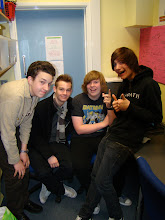
Enjoy
Nick

We decided in light of previous weekends, that realising now the possible difficulties we could face in the filming process, we could hopefully avoid these this coming weekend. Here are some notes on that meeting.
We could continue for a while with pointless, over specific, pedantic points but we feel we covered all the main issues.
Nick, Simon, Matt, Daniel
Daniel.
Here is the new revised script for the new film idea. It is a lot simpler than "The Streets Run Red" but follows the same general storyline with similar characters.
Matt, Nick, Daniel
The Case
We start with a black screen and the film company logo is shown. We hear a door bell and the screen fades * in to a long shot of a corridor with a door at the end. It is night time and there is low lighting. We are in a house. A man in his 20s walks towards the door. He is wearing a shirt with rolled up sleeves and a black tie. He is scruffy and looks very tired. As the screen fades in the music starts (Moonlight Sonata by Beethoven)
[We fade from black into a slow track towards a door at the end of a corridor. We hear a door bell ring.]*
He opens the door and looks outside. We get a MCU of him looking around as nobody is there. He goes back into the house and we revert to the first shot as he closes the door. We then go to a close up of him putting on the chain. We change to a LS from the other side of corridor and watch him walk to the back room. Now inside the back room we get a match on action as he enters the room and pan across the room with him (MLS). He sits down at a desk which is lit only by a lamp. Match on action as it changes to a MS (HA) looking down on the desk. It is covered in papers; badly organised, showing that he is obviously stressed. He has a mug of coffee which shows us that he is tired, and we see a cork board up against the wall with evidence on it. A CU of the board shows us that he is working on a crime case, therefore telling the audience he is some sort of detective. We cut back to the MS and see him writing.
We now get a brief character building montage. We get a CU and track of him picking up his mug and taking a swig of coffee. We fade to a pan left across the desk from a Birds Eye View which is a MCU, this shows all the paperwork scattered around. We fade to a pan right which is horizontal view of the desk seeing a picture of the detective and his girlfriend and then onto the cork board where we see his hand enter frame and pin up a post-it note (currently illegible).
We cut back to the CU of the front door and the chain is now off. *
Now back in the room we look from beyond the table with a MS. We see the detective working still. His lamp starts to flicker and turns off. When it turns back on again we see him fiddling with the light bulb and if you look carefully in the door way there is now a tall dark figure standing there. The light goes off again and when it comes back on the man is now standing right behind him preparing to strike. The light goes off a third time and we hear a slam, when light returns we see the detective has had his head slammed into the desk and is unconscious/dead? The villain is making his exit out the room.
We now get a canted angle and a small zoom from MCU to CU, of the detective’s head on the desk. It cuts to a LA LS of the villain leaving through the back door. He walks down some steps and into the garden. Match on action to forward track following him power walking down the garden towards the back gate. (Take lots of different variations of this to cut between?). He reaches the gate and we cut to a (match on action) CU of his hand trying to unlock it. He shakes it a bit and grumbles in discontent.
We cut to a LS of the gate and do a montage of quick CU cuts of him hopping of the gate, starting with his hands on top of the gate, pushing himself up, foot on the gate, and then jumping over to a match on action on the other side as he lands.
We then get a MCU of him straightening his jacket at which point we see a rose pinned to it. We cut back to a black and white version of the pan in which we see the crime board. There is a sudden CU on the post it note which we can now read to be saying:
“Villain known to have rose as calling card”
Next to this is a Polaroid photo of a rose. We cut back to the MCU and he walks out of shot. Match on action to a VLS of him walking down the alley. As he is going down we cut to a CU of his hand pulling his tie loose and we can see him breathing heavily. Cut back to the VLS slightly canted angle this time and he continues past the camera, match on action to a LS from the corner as he stops and looks around. We get a MCU of him wiping his hands of sweat on his jacket. A CU where he reaches into his jacket and pulls out a packet of cigarettes. We cut to a long shot and he has a shadow cast against a wall as he searches for his lighter. We realise there is not one, but two shadows on the wall. We cut to a slightly low angle CU looking at the villain’s face for the first time as he brings up his lighter to light the cigarette. He lights the lighter and we see a gun appear in the shadows behind him.
The screen fades and the music comes to a sudden halt and there is a gun shot. The title logo fades and zooms into the screen.
END
1. The Action: identify the event your idea is based around; what actually happens (discovery of a body, an illicit meeting, a witness seeing a crime being committed, a criminal act taking place)?
A detective is assaulted is his own home and appears to the view to be dead. The villain then escapes the scene of the crime via the garden and an alleyway before being confronted by he detective who now has a gun in hand.
2. The theme(s): what should it make the audience think about or feel, what 'issues' will it raise (revenge, sexuality, voyeurism, stalking, obsession, greed ect). The opening is associated to:
crime, enigma, suspense, death, motive, justice and retribution, secrecy.
3. The narrative: how is it structured - classic narrative pattern or break with convention, different time zones, flashbacks/forwards, dreams etc. Will there be dialogue? What about diegetic/non-diegetic sound?
It will be a linear sequence set in one time frame and filmed in real time except for one brief flashback that explains the link between the characters. There will be no dialogue as we feel that this would ruin the atmosphere. All sound will be diegetic except for the doorbell at the start and the gunshot at the end.
4. The character(s) who are they, identify their roles, what are their characteristics, including gender, appearance etc?
Anti-hero, villain, detective/gangster, male, trench coats and matching hats, red roses, guns, violence, calm and collected, slightly nervous.
5. The setting and choice of location: where is it set?
The setting is the villains house and specifically his office space where he does his work and has all of his evidence and files around him. The alleyway will be dark and creepy with low key lighting as opposed to the inside. The actual location is Nick's house, back garden and alleyway. We stumbled over this location after brainstorming new ideas at his house.
6. The mise-en-scene: identify colours, lighting, dress codes, the overall visual look.
Low saturation but contrasting colours which stand out e.g light and darkness. The outside shots will have a low saturation mixed with various filters such as a low glow effect which brings out the white/light in the shots, also maybe some colour correction to make it look exactly as we want. The characters will be dressed as gangsters with trench coats and the overall feel will be very 1970/80s to create a traditional film noir look.
7. The camera work: the style you are aiming for.
The camera work will be quite slow paced with lots of close-ups on the characters in order to show little background as this will clutter the shot. We only need to focus on the protagonist and his workspace anyway. This will help to create a montage sequence in th emiddle which we are looking to include to show time passing. As the villain starts to escape, however, the camera work and cuts will quicken up slightly to build tension and to be able to keep up with the action.
8. The editing: edited as a continuous sequence, use of cross cutting, use of montage, or combination?
The opening will feature non-linear editing, edited as a continuous sequence which focuses more on the aftermath of the attack rather than on the event itself. The editing will be quite slow paced and we want a lot of the shots to linger on-screen to create a relaxed and artistic effect so the audience has time to take all of the mise-en-scene in which is important in an arty film. As we mentioned before we will be looking to include a montage sequence.
9. Has your idea been 'tested' against the question on the previous brief sheet?
Yes, it has and it appears to be very workable provided we work hard and focus on every detail to create this film noir genre. We have had issues with the story and are correcting them but there is nothing wrong with the general idea of the film.
10. Group responses?
We all agree that the idea is a very good one, considering that we thought of it in one day and that if done right it could potentially look very good.
11. Teacher responses?
We contacted Ms Blackborow while at Nicks house at the weekend and she agreed that it would be wise to now put our efforts into this idea as our other seems dead in the water. This one seems equally strong if not better than our previous idea as it is simpler but should still contain a good story and eventually a good sequence.